

By Euronews
Published on
Iran and the United States agreed to continue negotiations after holding indirect talks in Oman on Friday focused on Tehran’s nuclear programme, despite continued tensions over the Islamic Republic’s violent crackdown of recent country-wide protests.
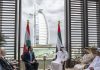
Iranian Foreign Minister Abbas Araghchi and US Middle East envoy Steve Witkoff led their delegations in Muscat for talks mediated by Oman, without publicly meeting face-to-face.
“In a very positive atmosphere, our arguments were exchanged and the views of the other side were shared with us,” Araghchi told Iranian state TV, adding the two sides had “agreed to continue negotiations, but we will decide on the modalities and timing at a later date.”
The talks were the first between the two countries since the United States joined Israel’s 12-day conflict with Iran in June with strikes on nuclear sites.
Araghchi said talks focused solely on the nuclear issue. The US had indicated Tehran’s backing for militant groups and its ballistic missile programme also needed to be on the agenda.
“Our discussions are focused exclusively on the nuclear issue and we are not addressing any other subject with the Americans,” Araghchi told the official IRNA news agency.
Witkoff was accompanied by Trump’s son-in-law Jared Kushner. Admiral Brad Cooper, commander of US Central Command, whose area of responsibility includes the Middle East, was also present, according to images published by the Oman news agency.
A source with knowledge of the talks told AFP the meetings took place at the residence of Omani Foreign Minister Badr Albusaidi.
Multiple sessions in the morning and afternoon saw both sides shuttling to and from Albusaidi’s residence. Albusaidi appeared to be acting as mediator, passing messages between the delegations.
Writing on X, Albusaidi described the talks as “very serious.”
“It was useful to clarify both Iranian and American thinking and identify areas for possible progress. We aim to reconvene in due course, with the results to be considered carefully in Tehran and Washington.”
No nukes for Tehran
The White House said it wants the talks to prevent Tehran from developing a nuclear bomb, an ambition the Islamic Republic has always denied.
The US delegation intended to explore “zero nuclear capacity” for Iran, White House Press Secretary Karoline Leavitt said, warning Trump had “many options at his disposal aside from diplomacy.”
“They’re negotiating,” Trump said of Iran on Thursday. “They don’t want us to hit them, we have a big fleet going there,” he added, referring to an aircraft carrier group he has repeatedly called an “armada.”
The US has deployed a naval group led by aircraft carrier USS Abraham Lincoln to the region.
The talks come just under a month after a wave of nationwide protests in Iran sparked by persistent hyperinflation and extreme hike in cost of living, which then turned into demonstrations against the clerical leadership in Tehran. Rights groups and insiders in Iran say the protests were repressed with a crackdown that left as many as 30,000 people dead.
Almost 51,000 people are confirmed to have been arrested, according to US-based Human Rights Activists News Agency.
Trump initially threatened military action against Tehran over its crackdown on protesters and told demonstrators “help is on the way.”
Iran has repeatedly vowed it will hit back if attacked.
The US originally wanted to hold the talks in Turkey, including regional countries, and to explicitly expand the agenda beyond nuclear issues, but changed course due to Iranian demands, a regional source close to the talks told AFP.
Additional sources • AFP