
By Euronews
Published on
•Updated
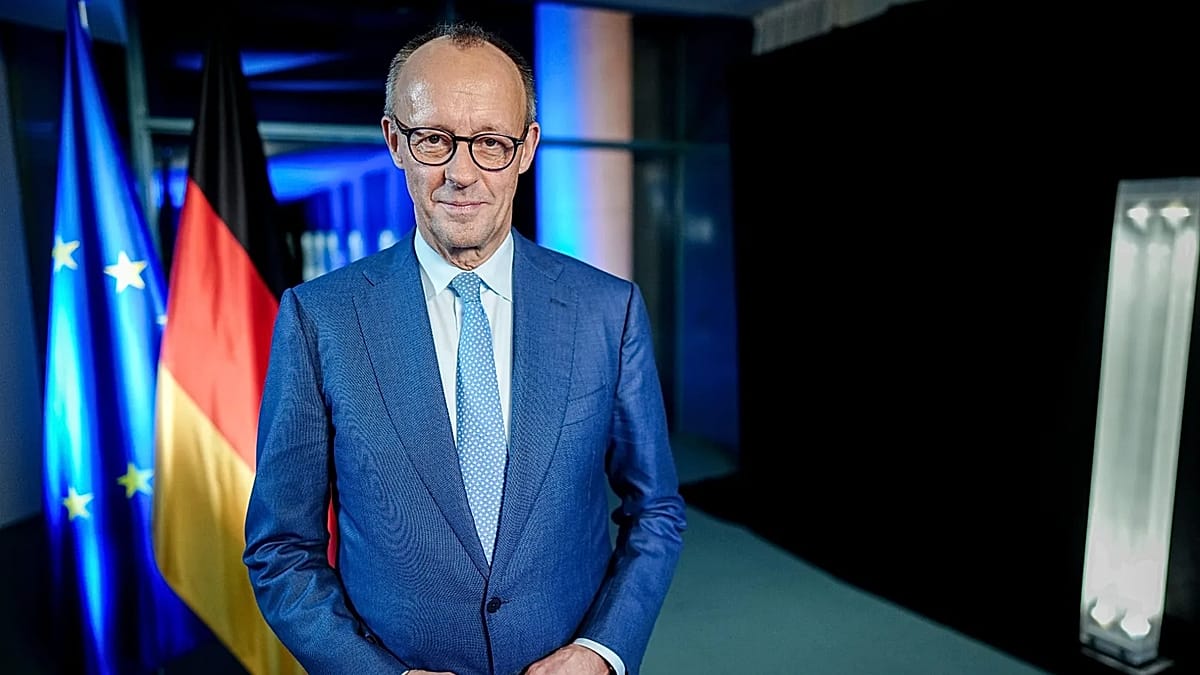
In his first New Year’s speech since being elected as Germany’s chancellor in February’s snap elections, Friedrich Merz describes a world that is uncertain, conflict-ridden and increasingly fragmented.
But he also attempted to reposition Germany in this shifting scenario, painting a picture not of appeasement, but self-assurance.
“We are not the victims of extraneous circumstances. We are not at the mercy of great powers. Our hands are not tied,” Merz said, openly contradicting the feeling of many who feel that Germany is losing influence and control in the face of global crises.
Instead, Merz emphasised Germany’s own ability to act, pointing out that the country is neither a victim of external circumstances nor powerless in the face of international developments.
Merz also touched on Russia’s full-scale invasion of Ukraine and reminded the audience that Ukrainians were once again starting the new year in extreme conditions, with little in the way of security, sometimes without electricity and often living under constant shelling.
“A terrible war is raging in Europe, one that poses a direct threat to our freedom and our security. Our economy is coming under pressure from necessary reforms, high costs and global trade conflicts,” Merz said.
At the same time, he made it clear that the war did not end at Germany’s borders.
“After all, we are seeing more and more clearly that Russia’s aggression was and is part of a plan targeted against the whole of Europe,” he said.
“Germany is also facing sabotage, espionage and cyberattacks on a daily basis.”
However, Germany is a secure country, said Merz, adding that this security cannot be taken for granted and that Europe must strengthen its deterrent capability and defend its own interests more consistently.
Merz’s New Year’s address appeared to be deliberately generalised, but he nevertheless placed a clear emphasis on greater European independence in security matters.
“At the same time, our partnership with the United States of America, which has long been the reliable guarantor of our security, is changing,” Merz said. “For us Europeans, this means that we must defend and assert our interests much more strongly by ourselves.”
In addition to foreign policy, Merz also spoke about structural changes that will shape the country in the long term. He cited global protectionism, strategic dependencies on raw materials and the changing relationship with the USA as potential risks to prosperity and stability.
Here, too, he combined diagnosis and aspiration: Germany and Europe must learn to make themselves less vulnerable.
In terms of domestic policy, the Chancellor conceded that many people felt that the government’s achievements so far were “not enough,” and pledged to continue with the work that had been started “even if it takes some time.”
At the same time, he announced further fundamental reforms, particularly to pensions and the welfare state. Merz cited demographic changes, rising costs and technological upheaval as reasons for the need to adapt.
The outlook of the speech focused on 2026, a year which, according to Merz, could be a moment of new beginnings for Germany and Europe.
This requires trust in Germany’s democratic processes, even if these are often lengthy and conflict-ridden, Merz pointed out.
Merz said that 2026 could be “a year of new beginnings,” that could see Germany and Europe “reconnect with decades of peace, freedom and prosperity.”