
A year after the Azerbaijan Airlines plane crash near the Kazakh city of Aktau, residents and first responders alike still think of the day when 38 people lost their lives.
On 25 December 2024 at 11 am Astana time (7 am CET), Aktau airport air traffic control reported that an Azerbaijan Airlines passenger jet flying from Baku to Grozny had declared an emergency and requested to land at the airport.
The aircraft, scheduled to land at 11:25 am, crashed just five minutes later between the airport and the village of Akshukyr, roughly 3 kilometres short of the runway.
The aircraft was carrying 67 people, including five crew members. 38 people perished in the crash, while 29 survived with injuries.
Doctors from the Mangystau Regional Emergency Medical Centre were the first to arrive at the crash site. Ospan Orazbekov told Euronews he saw it all happen before his very eyes.
“Together with a paramedic and an ambulance driver, I immediately drove to the airport. On the way, I saw the plane in the sky, moving extremely fast with its nose dipping toward the ground,” Orazbekov recalled.
“I was hoping the pilots could land on the runway, but the plane flew past the airport toward the village of Akshukyr. I told the driver we had to go after it,” he recalled.
“We were driving, keeping our eyes on the plane, but then black smoke appeared. We sped up and tried to get there as quickly as possible. When we arrived, we saw that the aircraft had broken into two parts,” Orazbekov says.
“The front section was on fire, so we immediately went to the tail section because there were people there. We did everything we could. We unbuckled eight injured passengers. Then I went deeper into the wreckage to see if there were children or pregnant women inside.”
“I remember every face of every person I rescued from the plane, and I still see them,” Orazbekov said.
In the first moments after the crash, locals rushed to the site. People driving by stopped to help passengers exit the plane. The injured were taken to the Mangystau Regional Multidisciplinary Hospital.
For resuscitation doctor Bakytzhan Koybekov, 25 December 2024 started like any other day. After the plane crash, the hospital was informed that people injured in the crash were on the way.
Doctors quickly held an emergency meeting and prepared beds and treatment areas. In total, 29 people were brought to hospitals in Aktau, eleven of them in critical condition in the intensive care unit.
“The patients were in critical condition. Many suffered head and brain injuries, broken clavicles, arms and shoulders. Some patients had every single rib broken,” says Bakytzhan Koybekov, head of ICU at the Mangystau Regional Multidisciplinary Hospital.
Residents of Aktau quickly responded to an urgent call. At the city’s blood centre, people lined up to donate blood and help those injured in the crash.
“As doctors, we deal with many emergencies every day, but we didn’t expect so many people at once. On the same day, Russian citizens were evacuated from the ICU by helicopter. Later, patients from Kyrgyzstan and Azerbaijan were gradually evacuated as their conditions stabilised,” he added.
“All patients received treatment and returned safely to their countries. We did everything we could. I’m grateful to my team, who worked day and night to care for the patients.”
Kazakhstan’s Emergency Situations Ministry reported that the fire in the plane’s burning section was extinguished within 30 minutes of the crash.
Crash site still marked by tragedy
In February, Kazakhstan’s Ministry of Transport published a preliminary report on the Flight 8243 crash, stating that the plane was struck twice within seconds by “external objects” — later determined to be shrapnel from exploding Russian air defence missiles — as it approached Grozny from Baku.
The pilots initially requested to divert to Mineralnye Vody Airport and Uytash Airport in Makhachkala, but after Russian air traffic control denied the landings, the crew declared a squawk 7700 and asked for an emergency landing at Aktau International Airport in Kazakhstan.
The aircraft was cleared to land by Aktau air traffic control, but after entering Kazakhstan’s airspace, it circled the runway twice before tragically crashing on its third approach.
On 28 December 2024, Russian President Vladimir Putin apologised to President Ilham Aliyev of Azerbaijan for the “tragic incident” involving the aircraft in Russian airspace, saying Ukrainian drones had been targeting Grozny without taking responsibility for the crash.
However, on 9 October of this year, during a meeting with Aliyev at a regional summit in Dushanbe, Putin admitted that Russia’s air defences were responsible for shooting down the Azerbaijani passenger jet.
Last year, while flying to St Petersburg for the informal CIS summit, Aliyev was informed about the plane crash while over Russian airspace and promptly ordered the aircraft to return to Baku.
Ahead of the tragedy’s first anniversary, Aliyev declined to attend this year’s informal CIS summit, held on 22 December in St Petersburg.
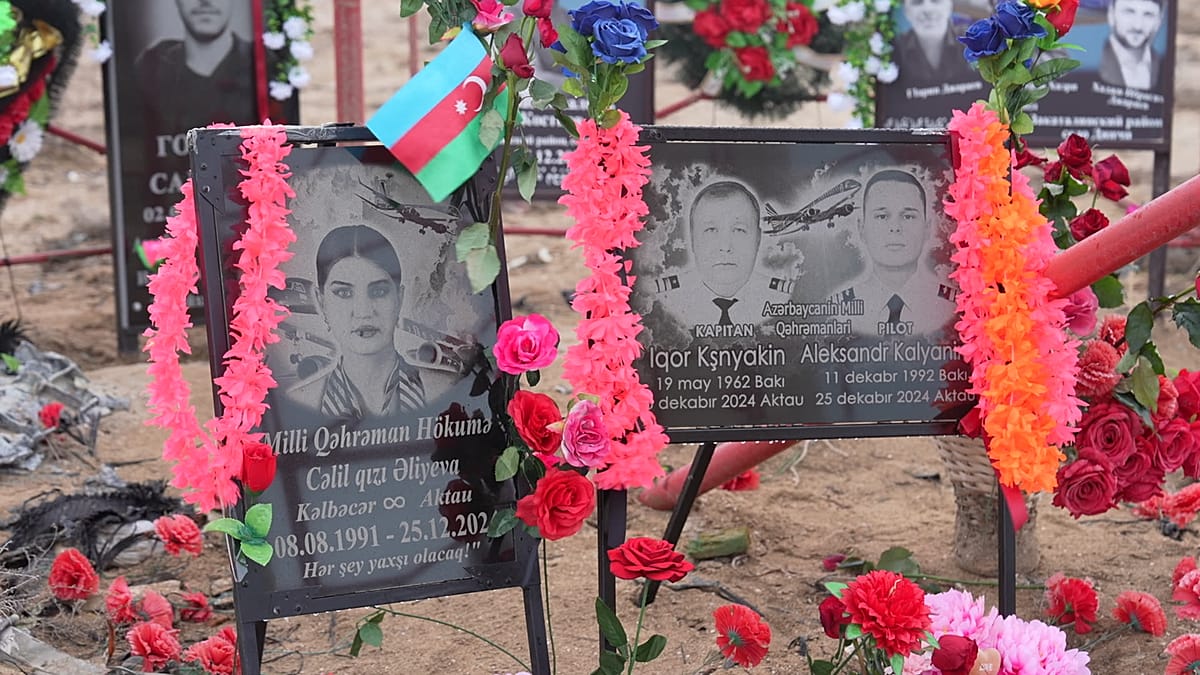
Even a year later, the crash site bears the marks of the tragedy. Scattered across the steppe are passengers’ personal items, oxygen masks, safety instructions, fragments of luggage, and melted fuselage pieces.
Residents of the Mangystau region have established a memorial at the site to honour the crew and victims of the crash.