
By Karl-Heinz Paqué, Chairman of the Executive Board of the Friedrich Naumann Foundation for Freedom
Published on
The opinions expressed in this article are those of the author and do not represent in any way the editorial position of Euronews.
It was a picture of misery and humiliation for the European Union. At the end of July 2025, Ursula von der Leyen and Donald Trump unveiled the outcome of their so-called tariff negotiations in Scotland: Washington’s 15% tariffs.
In return, Europe promised massive investments in the US – for nothing more than an assurance from Trump that his threat of even higher duties would not be carried out.
In other words, it amounted to little more than outright blackmail, with no genuine negotiation on equal terms. Further setbacks for Europe may now be looming.
One case in point is the “Greenland affair”: Trump has bluntly threatened – without regard for international law – to annex the vast island, buy it, or lure Greenlanders with financial incentives so generous that Denmark would be unable to compete.
Europe has reacted with indignant calls for solidarity in response to the United States under Trump. Yet it takes little imagination to foresee that the EU’s NATO members – despite their formal obligation to come to Denmark’s defence – might ultimately fail to act if the US were simply to create a fait accompli in Greenland and raise the star-spangled banner over the island’s ice.
There would undoubtedly be loud protests, but Europeans would not trigger a war within NATO over such an incident.
The core problem is straightforward: Europe’s NATO members simply lack the power to deter a unilateral US act of aggression through credible threats in advance – let alone to reverse it afterwards with a military response.
The same applies in the economic sphere. If the EU were to threaten the US with a hard trade war, Washington could at any time call into question its NATO security guarantees, with potentially devastating consequences for Europe’s security vis-à-vis Putin’s Russia.
In such a case, Europe’s combined economic strength would be of little help, because in the final analysis, security matters more than trade. In short, Europe is permanently vulnerable to blackmail.
The reason lies in the transatlantic imbalance of military power, the result of decades of underinvestment by European countries in their defence capabilities. This was tolerable for Europe as long as confidence in its alliance partner, Washington, remained stably high.
Trump – this is his historical “achievement” in his second term in office – has destroyed that trust in remarkably short order.
He has definitively brought the post-war era to an end, the era that began in 1946 with the Cold War.
He has reverted to the traditional 19th-century philosophy of US foreign and security policy: the notorious Monroe Doctrine.
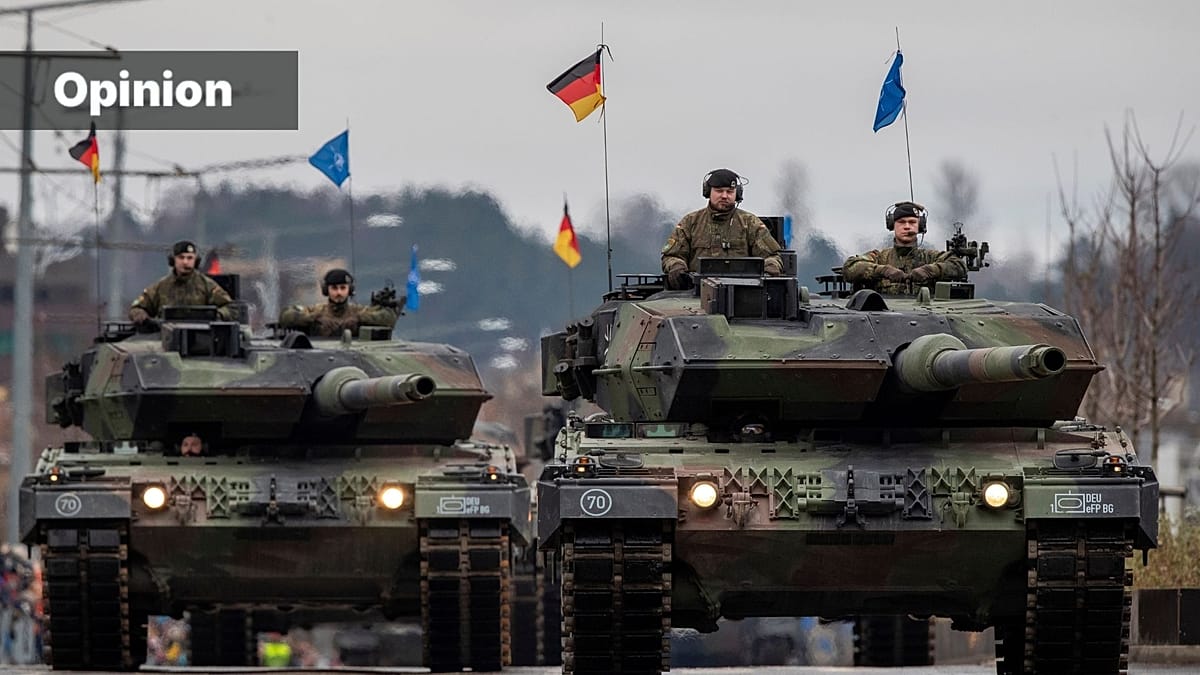
It is therefore clear that even within NATO, Europe can no longer rely on the United States. The only consequence is this: Europe must rearm on a massive scale.
The benchmark of 5% of GDP for defence agreed at the NATO summit in 2025 is an important step in the right direction.
Harbour no illusions
The gap with the US will remain enormous for years, if not decades, simply because a vast investment backlog has accumulated over at least three decades.
In the nuclear domain, moreover, it is not yet clear how this gap could be closed politically. Additional economic bottlenecks also come into play.
First, the European defence market – unlike its American counterpart – remains far from integrated. As a result, the classic advantages of the division of labour in weapons production have yet to materialise.
This, too, is the consequence of a lack of trust – this time among European partners themselves, who were unwilling to rely on one another and instead pursued narrowly defined technological self-interests. This must change.
Second, Europe – and Germany in particular – suffers from a latent competitive disadvantage: economic growth here is systematically slower than in the US, making it ever more difficult, both socially and politically, to carve out the resources that must be reserved for defence.
Diverting 5% of a stagnating GDP away from consumption is simply far harder than diverting 5% from a dynamically growing economy.
This creates an urgent need for radical economic reforms in Europe – and especially in Germany – if the military objective is to be achieved.
There is no going back
Europe is facing its most serious political challenges in decades. The credit for this goes to Trump.
Yet Europeans should not complain. Under Trump’s predecessors and during his first term, they casually ignored the clearly visible hardening of Washington’s position.
As a result, they now face a particularly high price. Whether they are willing and able to pay it remains to be seen. The future will provide the answer – and that future begins in 2026.
We are at a turning point. And there is no going back.
Karl-Heinz Paqué serves as Chairman of the Executive Board of the Friedrich Naumann Foundation for Freedom and President of the Liberal International.