
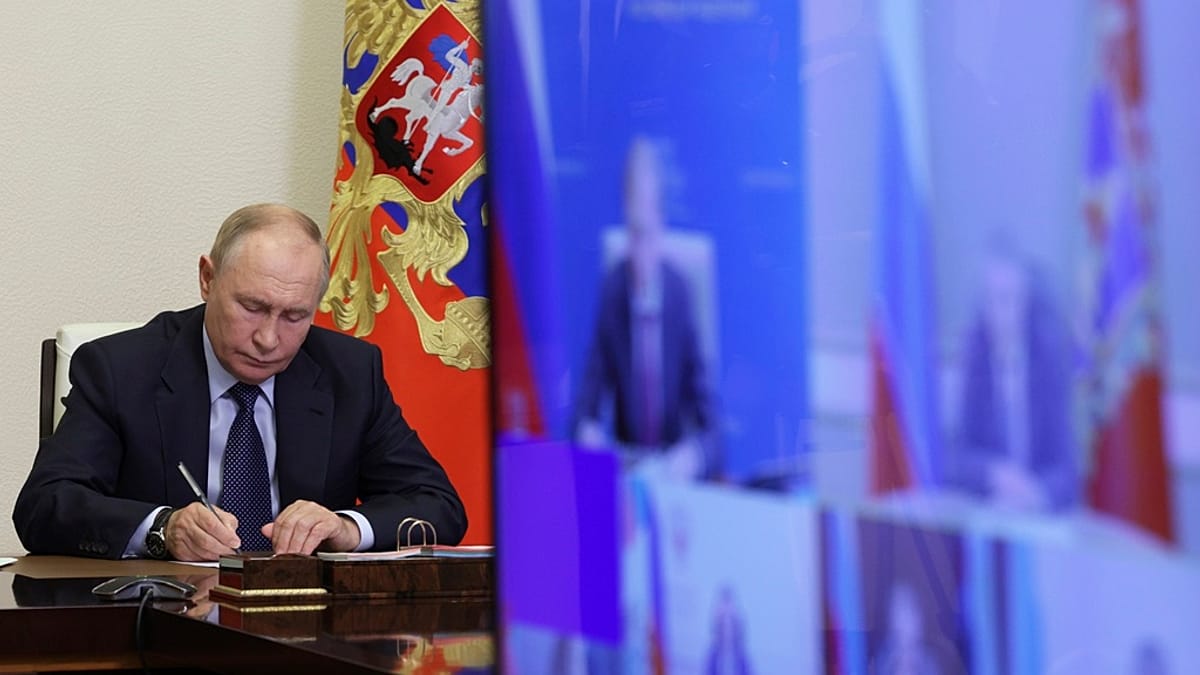
Moscow stuck to its guns again on Wednesday, furthering its claims of an alleged Ukrainian drone attack on President Vladimir Putin’s dacha, in what allies have described as an apparent attempt to throw a spanner into US-led peace talks to end Russia’s all-out war.
In the latest attempt at backing the Kremlin’s claims, the Russian defence ministry released a video purportedly showing a downed drone it said Kyiv launched at Putin’s residence in Novgorod overnight on Monday.
The video shows a damaged drone lying in snow in a forested area at night, next to what appears to be a masked member of Russian military personnel talking about the UAV as the footage shows close-ups of the drone and its internal parts.
In another segment of the footage, two masked Russian troops sitting inside a military vehicle state that “On the night of 29 December, an attempt was made to strike an aircraft-type UAV on the territory of a protected facility.”
No evidence was provided to confirm that the alleged drone attack took place near Putin’s residence. Euronews could not independently verify the authenticity of the footage or the location where it was filmed.
Putin’s spokesperson Dmitry Peskov initially dismissed providing further proof to back Moscow’s claims, stating on Tuesday, “I don’t think there needs to be any evidence here.”
‘No noise, no explosions,’ Valdai residents say
Putin’s residence, also known as Dolgiye Borody or “Long Beards,” is situated near the town of Valdai, whose residents told domestic media outlets they did not witness any signs of a drone attack.
“There was no noise that night, no explosions, nothing,” one resident told Mozhem Obyasnit outlet. “If something like that had happened, the whole town would have been talking about it.”
Russian Foreign Minister Sergei Lavrov said Monday that an alleged Ukrainian drone attack involved 91 long-range drones.
“Such reckless actions will not go unanswered,” Lavrov told Interfax news agency, stating Moscow’s negotiating stance would shift following.
Lavrov did not clarify whether Putin was present at the residence during the alleged attack.
Russian foreign minister’s figures contradicted the official report from the Russian Defence Ministry, which first claimed that its forces took down a total of 89 Ukrainian drones overnight on Monday, 18 of which in the Novgorod region.
Putin’s Valdai dacha — a vacation retreat for top-level officials since the Soviet times — is protected by significant air defence installations including at least a dozen surface-to-air batteries, according to reports.
‘Deliberate distraction’
Kyiv immediately dismissed Moscow’s claims of the attack. Ukrainian President Volodymyr Zelenskyy shot back at Moscow’s claims, calling it “another lie from the Russian Federation”.
“It is clear that yesterday we had a meeting with (US President Donald) Trump, and it is clear that for the Russians, if there is no scandal between us and America, and we are making progress, for them it is a failure,” Zelenskyy stated in a conversation with journalists on Monday afternoon.
“They do not want to end this war, they are only capable of ending it through pressure on them. Well, I am sure they were looking for reasons,” he added.
Since then, several European and US officials echoed Zelenskyy’s belief that by insisting on the alleged attempt on Putin’s life, Moscow is deliberately derailing the US-led peace talks, which US President Donald Trump has been actively pushing forward in recent weeks.
On Wednesday, EU foreign policy chief Kaja Kallas accused Russia of promoting “unfounded claims,” branding the allegation as a “deliberate distraction”.
“Moscow aims to derail real progress towards peace by Ukraine and its Western partners,” Kallas wrote on X.
One day earlier, US ambassador to NATO Matthew Whitaker also cast doubt on Russia’s allegations, stating he would want to see US intelligence instead.
“It is unclear whether it actually happened,” Whitaker said in an interview for Fox Business.
“It seems to me a little indelicate to be this close to a peace deal, Ukraine really wanting to get a peace deal done, and then to do something that would be viewed as reckless or not helpful,” Whitaker added.
Ukraine and its allies have previously accused Moscow of intentionally stalling on any ceasefire or peace agreements, while the Kremlin continued to repeat its maximalist demands as a prerequisite for talks to progress.
Merz warns of hybrid war
On Monday, the Kremlin said Putin informed US President Donald Trump of the alleged Ukrainian attack during the call and that this led to Moscow’s change in its position in the negotiations as announced by Lavrov, Russian state-run media reported.
Asked about the alleged attack later on Monday, Trump — who spoke to the press in Florida together with Israeli Prime Minister Benjamin Netanyahu — said, “I don’t like it, it’s not good.”
“It’s a delicate period of time, it’s not the right time. It’s one thing to be offensive … it’s another thing to attack his house,” the US president added. “I was very angry about it.”
Quizzed on whether Washington had any intelligence to corroborate Moscow’s claims, Trump said, “Well, we’ll find out. You’re saying maybe the attack didn’t happen, it’s possible too, I guess.”
“But President Putin told me this morning it did.”
Meanwhile, German Chancellor Friedrich Merz accused Russia of pursuing a hybrid war against Europe in his New Year’s address on Wednesday.
“A terrible war is raging in Europe, one that poses a direct threat to our freedom and our security. Russia is continuing its war of aggression against Ukraine with undiminished intensity, however,” Merz said.
“And this is not a distant war that does not concern us. After all, we are seeing more and more clearly that Russia’s aggression was and is part of a plan targeted against the whole of Europe.”
“Germany is also facing sabotage, espionage and cyberattacks on a daily basis,” he added.