
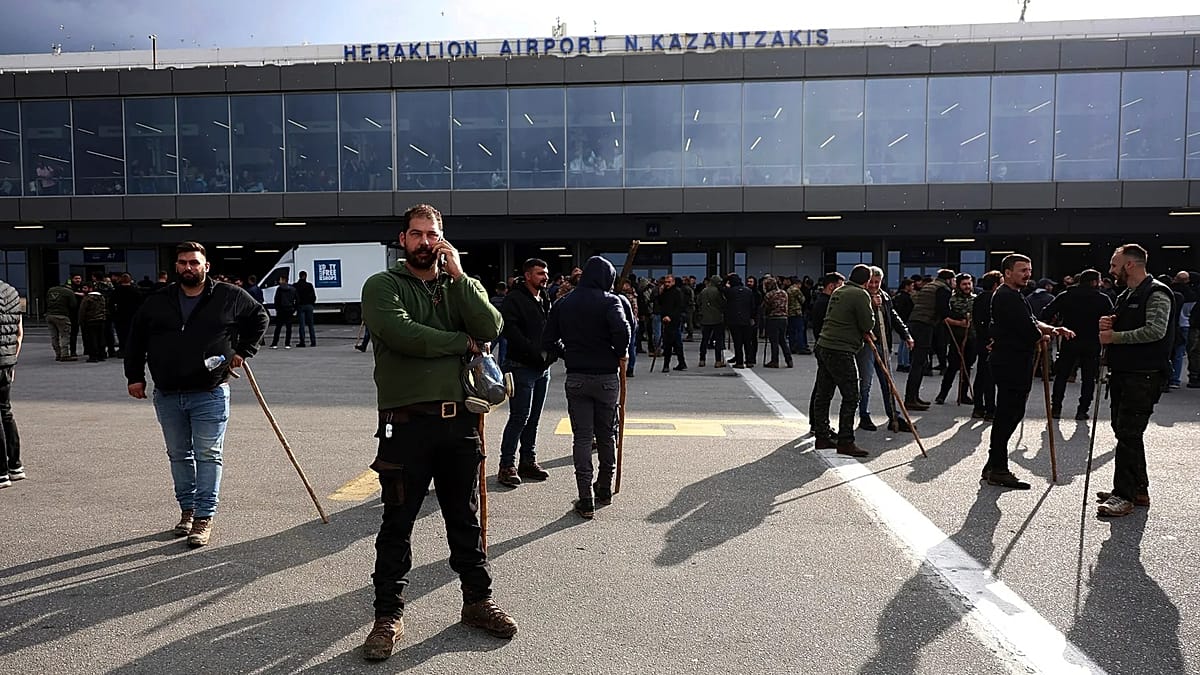
Farmers protesting delays in subsidy payments forced their way onto the airfield of the international airport on the southern Greek island of Crete on Monday, evading riot police who used tear gas and stun grenades to keep them back.
Images from local media showed dozens of farmers standing on the apron at the Nikos Kazantzakis international airport in Heraklion, the main town on Crete, forcing the airport to suspend all flights.
Clashes also broke out near the airport of Crete’s second-largest city of Chania, with riot police using tear gas to disperse protesting farmers who pelted them with rocks and overturned a police patrol car, local media reported. Two people were reportedly injured in the clashes.
The demonstrations in Crete are the latest escalation in farmer protests over delays in the payment of European Union-backed agricultural subsidies, following a scandal that revealed fraudulent subsidy claims.
Farmers have deployed thousands of tractors and other agricultural vehicles at border crossings and key points along highways across the country, periodically stopping traffic and threatening to completely block roads, ports and airports.
On Friday, riot police fired tear gas at protesting farmers attempting to block the main access road to the international airport outside the northern Greek city of Thessaloniki.
Police have been enforcing traffic diversions in several parts of northern and central Greece to circumvent the blockades, while farmer roadblocks at the country’s northern borders with Bulgaria, Turkey and North Macedonia have already hampered truck traffic, causing long queues of freight vehicles.
“Everyone must understand that problems are solved through dialogue and some red lines should not be crossed,” Greek Minister of Rural Development and Food Costas Tsiaras said on state television on Monday.
Payment delays
The payment delays come as authorities review all requests following revelations of widespread fraudulent claims for EU farm subsidies.
Protesters have argued that the delays amount to collective punishment, leaving honest farmers in debt and unable to plant their fields for next season.
Greece’s farming sector has also been hit this year by an outbreak of goat and sheep pox that led to a mass cull of livestock.
Michalis Chrisochoidis, the minister for public order, said last week that the government remained open to talks with protest leaders, but warned that it wouldn’t tolerate the shutdown of major transit points.
Protests by farmers are common in Greece and similar blockades in the past have sometimes severed all road traffic between the north and south of the country for weeks.
The subsidy scandal prompted the resignation of five senior government officials in June and the phased shutdown of a state agency that handled agricultural subsidies.
Dozens of people have been arrested for allegedly filing false claims in response to an investigation led by the European Public Prosecutor’s Office (EPPO).
During a preliminary investigation by EPPO, some 324 people were identified as recipients of subsidies totalling €19.6 million.
The independent EU body dealing with financial crime said at the end of October that the investigation was linked to “a systematic large-scale subsidy fraud scheme and money-laundering activities.”
Additional sources • AP