

Police station opens at Hitler’s birthplace in bid to rid site of Nazi link
-
Published
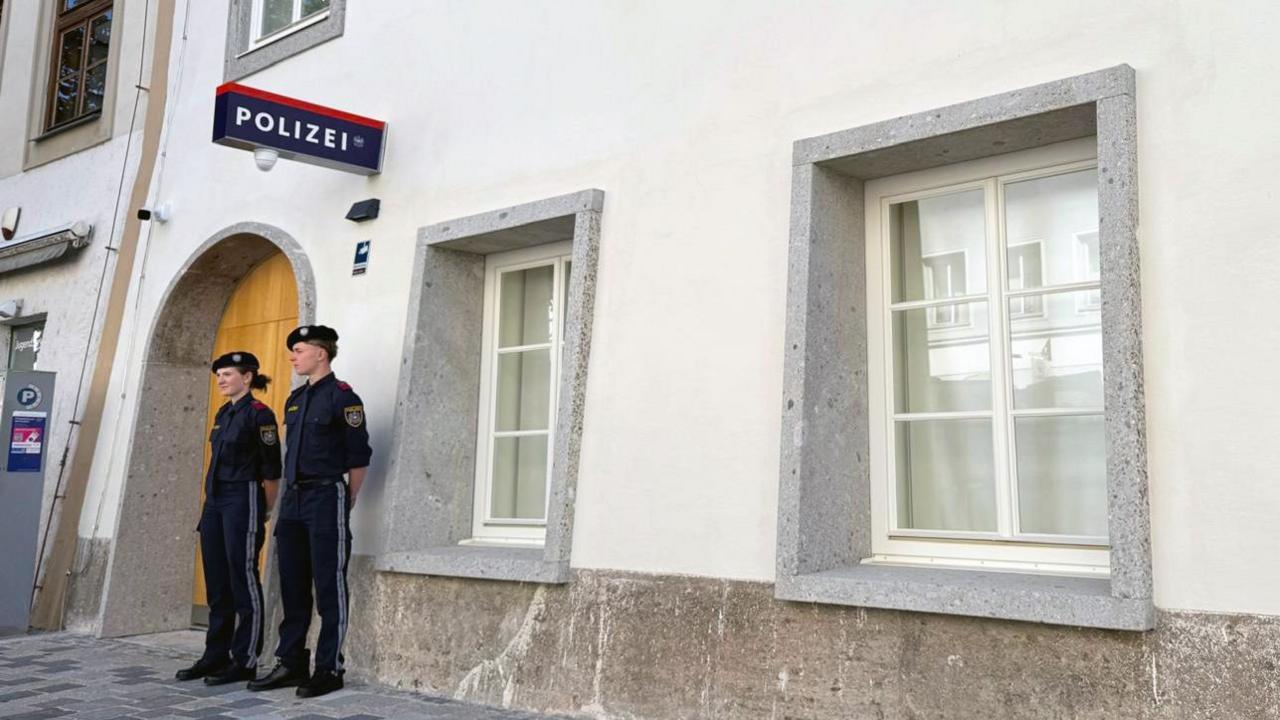
Austria has opened a police station in the house where Adolf Hitler was born in the town of Braunau am Inn.
It follows years of controversy about what to do with the 17th-Century former inn, where Nazi dictator Adolf Hitler was born in April 1889.
The building has now been substantially refurbished and its facade changed, but it has been a huge headache for Austrian authorities, who want to prevent it from becoming a site of neo-Nazi pilgrimage.
Hitler only lived in Salzburger Vorstadt 15 for a few weeks before his family moved to another address in Braunau. They left the town for good when he was three years old.
Hitler returned briefly to Braunau in 1938, on his way to Vienna, after he annexed Austria to Nazi Germany.
The opening ceremony for the police station, featuring police musicians playing a tuba and other brass instruments, was attended by Interior Minister Gerhard Karner and other local dignitaries.
Austria was taking “responsibility” for the “terrible legacy” of the past, said Karner. While deciding what to do with the building had not been easy, Karner believed the police station marked “a new chapter” for the building.
“This house will now become a place of democracy, rule of law, security, freedom and human dignity,” he said.
A Catholic police chaplain then blessed two crosses which will hang in the new police station.
For decades, the interior ministry had rented the building from its former owner, a local woman called Gerlinde Pommer. It paid her a generous rent, in an attempt to prevent the house being used as a site for extreme right-wing tourism.


The building was used for many years by a local charity as a day centre and workshop for people with special needs. But it was forced to move out in 2011, when Pommer blocked renovations.
She also repeatedly refused to sell the property to the government.
The house remained empty for several years, while the authorities and Pommer argued over terms.
In 2016, Austria’s parliament passed a law allowing the government to seize the house from Pommer. It paid her compensation of €812,000 (£690,000). She later took the government to court, saying the sum was too low, but lost her case.


The interior minister at the time, Wolfgang Sobotka, said the building should be torn down and a new one erected in its place. It was an echo of an earlier offer by a Russian MP who said he wanted to buy the house and blow it up.
But there was a storm of criticism, with many saying that destroying the house would be tantamount to denying Austria’s Nazi past.
In 2019, the government announced plans to turn it into a police station and initiated an EU-wide competition for architects to submit designs.
Millions of euros were spent refurbishing the old yellow building, which now looks very different from before.
Now painted white, inside and out, the building is full of gleaming oak woodwork. An old winding staircase and arched entrance hall have been preserved.
It looks very different from when the Lebenshilfe charity was running a small shop in one of the rooms at the front, when I last went inside almost 20 years ago.
Police Chief Inspector Ludwig Heise said he was happy to have such “a great, modern building” to work in. “We have more space,” he said, “but otherwise it is like any other police station in Austria.”


Not everyone is happy with the decision to open a police station there, with some arguing it sent the wrong signal.
Some had wanted the house to become a centre of responsibility, confronting the Nazi past. Others, like local historian Florian Kotanko, say they would have liked to have seen the Lebenshilfe charity return.
“But even this charity organisation did not want to come back because they thought they would be used as a fig leaf for a political discussion, and so the government had to decide in another way,” Kotanko told the BBC.
There is no sign on the house about its history and the building features security cameras to record the activities of any potential neo-Nazi pilgrims.
All that links it to Hitler is a stone on the street outside, which was erected in 1989.
It says: “Never again Fascism; In memory of millions of dead.”
The stone comes from the nearby former concentration camp at Mauthausen.
Hitler’s name does not appear. However, Florian Kotanko believes the site’s history will never go away even if fewer neo-Nazis pay a visit.
“You have to deal with it, and so we all try to deal with it in an open and correct way. It’s not a matter of being proud, but it’s a matter of dealing with the fact.”