

Will Grant,Central America correspondent, Tegucigalpaand
Vanessa Buschschlüter

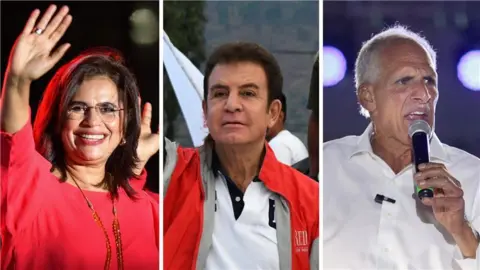
Early results in the Honduras general election show the two leading presidential candidates are locked in a “technical tie”, the country’s electoral authority has said.
Right-wing candidate Nasry Asfura leads former TV host Salvador Nasralla by just 515 votes, the President of the National Electoral Council (CNE) Ana Paola Hall said in a post on X.
Hall also called for “patience and prudence” adding that the manual count of ballot papers was still underway.
The tie comes amid growing tensions over delayed election results in the country. The website of the electoral council has also collapsed, adding to public fears about problems with the count.

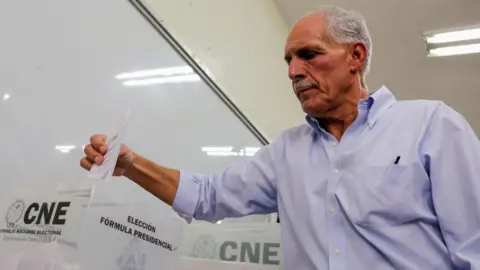
Asfura has the backing of US President Donald Trump, who has threatened to cut financial aid to the Central American nation if his preferred candidate does not win.
The outgoing president, Xiomara Castro of the left-wing Libre party, was barred by the constitution from standing for a second term. She backed Rixi Moncada.
With 6.5 million registered voters in the country, officials said voter turnout was expected to be strong, but no official figures have yet been released.
Many Hondurans had a sense that this would not be an entirely straightforward election but few would have foreseen the vote count being this close.
The webpage of the electoral council collapsed, apparently from the sheer traffic to the internet site, with the error message only compounding fears among voters of problems with the count.
People are keen to avoid an extended period of uncertainty or legal challenges over the result, which could be the case if the numbers remain close.
Shortly before casting their ballots, voters at a farmers’ market in Tegucigalpa spoke of their desire for change.

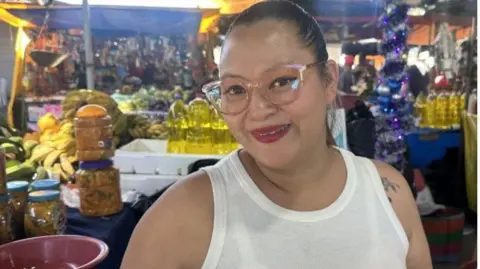
“People must vote based on reality in front of us, and not stay blindly loyal to any party colours,” insisted walnut-seller Nicole Castillo, adding that she believed that meant acknowledging the ingrained corruption in Honduran politics.
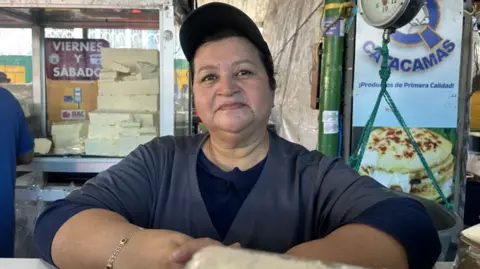
Nolvy Oriales, who owns a cheese counter nearby, said that her main motivation for voting was also to stamp out corruption and cronyism.
“I think we need to try someone new, someone who hasn’t been in power before, because these last few years have been very, very tough,” she said.
For many, the person who represents a new start is Nasralla of the Liberal Party, who has portrayed himself as the man who will put an end to corruption in Honduras if he is elected.
Although he was the vice-president for a time alongside incumbent Xiomara Castro, the two fell out and he resigned. Most know him best from his work as a television sports presenter.
The other option in front of those who wanted a break with the governing Libre party was Asfura, the candidate favoured by Trump.
Trump wrote on his Truth Social platform on Friday that the US would be “very supportive” if centre-right candidate Asfura won the presidential election.
“If he doesn’t win, the United States will not be throwing good money after bad, because a wrong Leader can only bring catastrophic results to a country, no matter which country it is,” Trump added.
But the US president’s last-minute intervention angered many as they went to the polls.
Casting his ballot at a school in Tegucigalpa, Minister of Infrastructure and Transport Octavio Pineda told the BBC that President Trump’s social media posts amounted to meddling.
“It’s totally electoral interference by the US president and we have publicly denounced it as such. We heard his words, but we don’t share his views.”
In one social media post, Mr Trump also controversially promised to pardon the disgraced former Honduran president, Juan Orlando Hernández, who is currently serving 45 years in a US prison for smuggling drugs and weapons.
“Remember, it wasn’t even the Honduran justice system which tried and sentenced our ex-president for drug trafficking. It was the US Attorney General’s office itself,” recalls Minister Pineda.
Meanwhile, Asfura has carefully tried to distance himself from Hernández.
On Friday he told news agency AFP that he has “no ties” with the ex-president, and that “the party is not responsible for his personal actions”.
For now, the vote count goes on, and the tension in Honduras continues to rise.
People have bad memories of street violence following disputed election result in 2017 when Juan Orlando Hernández claimed victory in a vote count which was questioned by international observers and the Organisation of American States (OAS).
Pitched battles between protesters and the police lead to at least 20 deaths.
No-one wants a repeat of those dark days, and people remain hopeful that calm will prevail.
Yet some shop owners have reportedly boarded up their businesses and some employees are staying away from work, at least until the drama of the vote count is over, and the name of the president-elect is clear.