
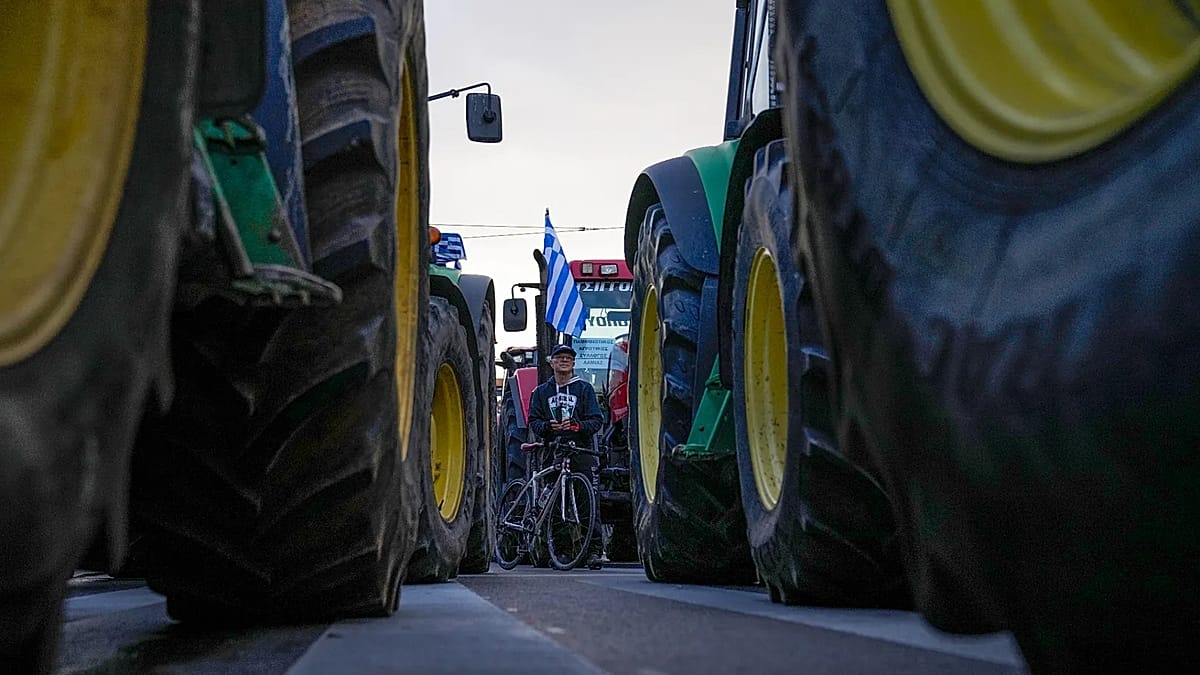
Farmers in northern Greece disrupted traffic at border crossings on Wednesday in an escalating protest over delayed European Union-backed subsidy payments linked to an investigation into a corruption scandal.
Convoys of tractors blocked routes to North Macedonia, Bulgaria and Turkey forcing drivers into lengthy detours.
In the central city of Larissa, farmers emptied milk in the main square before continuing their march to reinforce local motorway blockades.
Further north in Serres farmers set up road blockades and some bypassed police checkpoints to march on the customs office in Promahona, near the border with Bulgaria.
Greek Prime Minister Kyriakos Mitsotakis said the government is open to dialogue with farmers but cautioned against disruptive protests.
“I think that our farmers also understand that extreme actions, prolonged closures of highways, customs closures, airport closures, these are actions that do not help their efforts,” Mitsotakis said.
“They cause problems for other social groups, all the more so when the government has committed itself to making December a month of substantial income support for them, with the payment of substantial amounts,” he explained.
Protests by farmers are common in Greece, but the latest unrest erupted over delays in subsidy payments following revelations of widespread fraudulent claims for EU funds.
The scandal prompted the resignation in June of five senior government officials and the phased shutdown of a state agency that handled agricultural subsidies.
Dozens of people have been arrested across Greece in recent weeks for allegedly filing false claims in response to an investigation led by the European Public Prosecutor’s Office (EPPO).
During the preliminary investigation, some 324 people were identified as recipients of subsidies totalling €19.6 million, according to the EPPO.
The independent EU body that deals with financial crime said at the end of October that the investigation was linked to “a systematic large-scale subsidy fraud scheme and money-laundering activities.”
Greece’s Minister for Public Order Michalis Chrysochoidis said this week the government would not tolerate the shutdown of major transit points, including ports and railway hubs.
Serious incidents on Sunday
The wave of protests began on Sunday and was accompanied by incidents in the villages of Nikaia and Platykampos in Larissa, when farmers attempted to approach the motorway and clashed with riot police.
Two demonstrators and two police officers were injured, according to a statement by the ELAS resistance movement.
According to police, two arrests were made in Platykambos, one for violence against officials, damage and resistance and the second for damage. A third arrest was made at the Nice junction for bodily harm and resistance.
At the Larissa courthouse, farmers from the Nikaia blockade renewed their “appointment” after Sunday’s mobilisation outside the Larissa Police Directorate, calling for the release of those arrested.
The protests are expected to spread across Greece until Friday, with more road blockades, a tactic frequently used by farmers to put pressure on authorities.
Additional sources • AP