
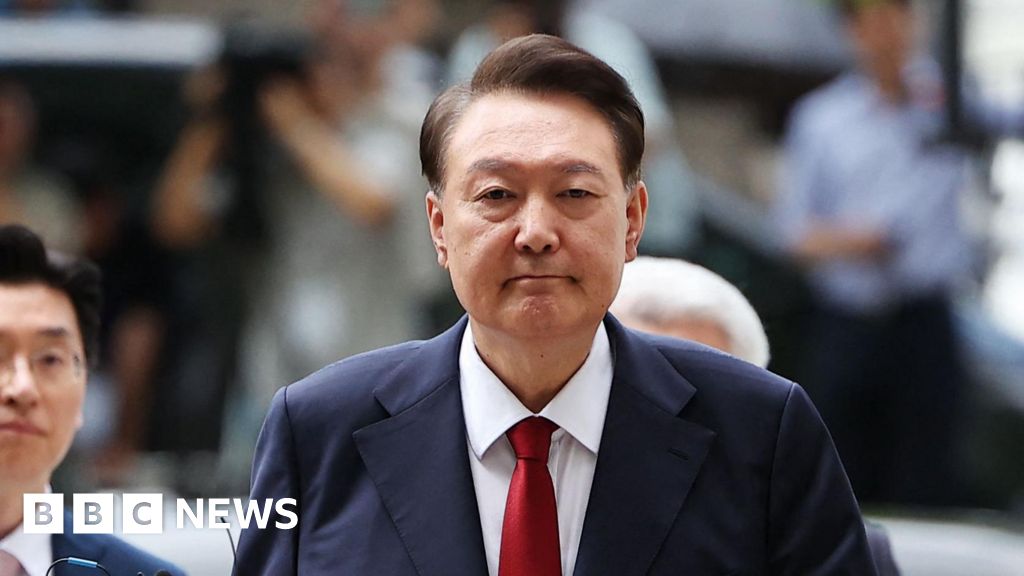
Prosecutors have asked for South Korea’s former president Yoon Suk Yeol to be handed a death sentence if he is found guilty over his botched attempt to impose martial law.
A court in Seoul heard closing arguments in Yoon’s trial, in which he was accused of being the “ringleader of an insurrection”.
The charge stems from Yoon’s attempt in December 2024 to impose military rule in South Korea – an act that lasted just hours but plunged the country into political turmoil. He was later impeached by parliament and detained to face trial.
Yoon has denied the charges against him, arguing that martial law was a symbolic gesture to draw public attention to the wrongdoings of the opposition party.
Leading an insurrection – the most serious charge against Yoon – carries sentences of the death penalty, or life imprisonment. Under South Korean law, prosecutors had to ask the judge for either one sentence or the other.
South Korea has not executed anyone in nearly 30 years. In 1996, former military dictator Chun Doo-hwan was given the death penalty for seizing power in a military coup in 1979, though his sentence was later commuted to life imprisonment.
The prosecutors in Yoon’s case argue that although no one was killed in his martial law attempt, Yoon’s intent was no less violent.
Closing their arguments at Seoul Central District Court on Tuesday, prosecutors said the former president had been motivated by a “lust for power aimed at dictatorship and long-term rule”.
“The greatest victims of the insurrection in this case are the people of this country,” they told the court.
“There are no mitigating circumstances to be considered in sentencing, and instead a severe punishment must be imposed,” they said.
Prosecutors had called to the stand the military commander who testified that Yoon had ordered the arrest of lawmakers during his abortive coup.
They also presented as evidence the memo made by one of the planners of the martial law, a former military officer, containing the suggestion of “disposing” of hundreds of people including journalists, labour activists and lawmakers.
Yoon’s insurrection trial has been merged with those of two other senior figures in his administration, former defence minister Kim Yong-hyun and former police chief Cho Ji-ho.
Prosecutors sought life imprisonment for Kim, and 20 years in jail for Cho for carrying out Yoon’s illegal orders. There are five other defendants.
Yoon was in court to hear the final legal arguments. He has argued that as president, he had the power to declare martial law. Yoon was quoted by Yonhap news agency as saying he had done so to fend off the “wickedness that would ruin the nation”.
Legal arguments were expected to end last Friday, but continued into Tuesday amid reports defence lawyers had delayed proceedings.
The court is expected to deliver its verdict in February. Sentences sought by prosecutors are not always upheld in courts in South Korea.
Yoon, 65, was removed from office in April, and is the country’s first sitting president to be taken into custody.
He has been detained for months while facing several criminal trials. Last month, prosecutors sought a 10-year prison term for Yoon for obstruction of justice and other charges related to his martial law attempt.
On 3 December 2024, Yoon shocked the country – and the world – by declaring martial law over South Korea. He said at the time it was to protect the country from North Korean communist forces, but some saw it as a ploy by Yoon to get a grip on power amid domestic political woes.
The short-lived martial law declaration sent South Korea into months of political turmoil, while Yoon became South Korea’s first sitting president to be arrested and charged.
South Korea’s incumbent president, Lee Jae Myung, was elected in June following a snap election after Yoon’s impeachment.
Despite his downfall, Yoon retains loyal supporters in right-wing circles who see him as a martyr who dared to rail against the liberal Democratic Party led by Lee.