
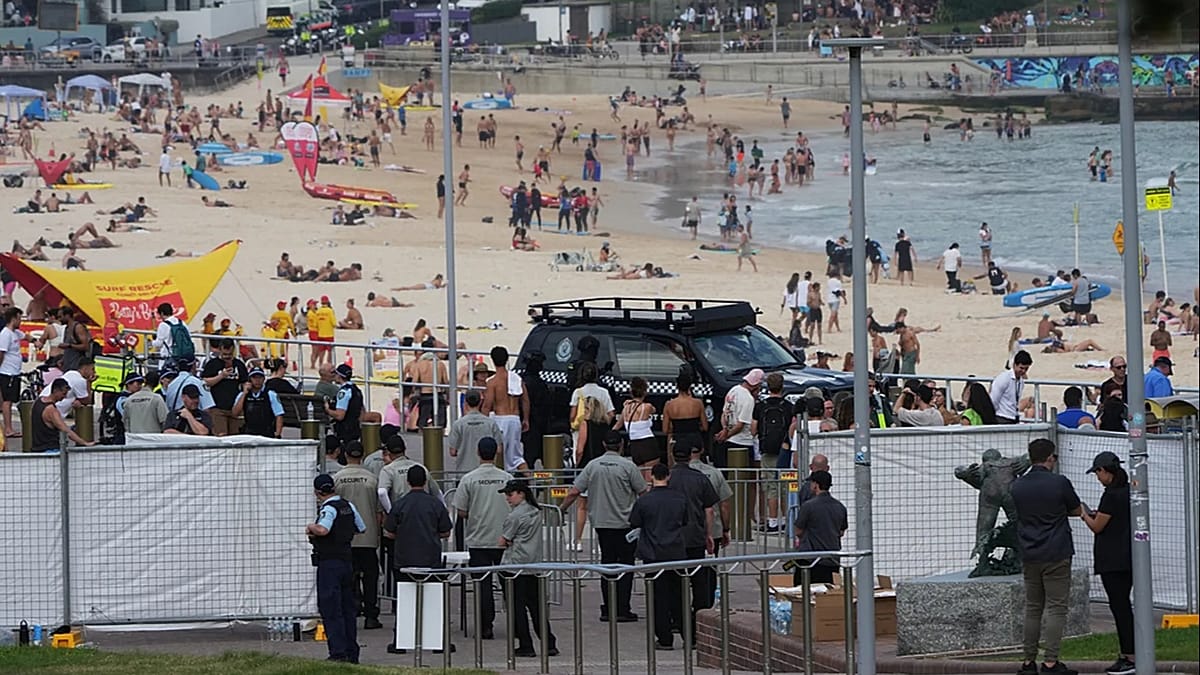
The two gunmen accused of killing 15 people at Sydney’s Bondi Beach threw homemade explosive devices, including tennis ball bombs, which failed to explode, at a crowd attending a Hanukkah celebration at the famed beach, according to Australian police.
The breakthrough comes after the police statement of facts was made public following the 24-year-old son, Naveed Akram’s, video court appearance from a Sydney hospital on Monday.
The pair also both conducted “firearms training” in a rural area of New South Wales outside of Sydney, the Australian Broadcasting Corporation (ABC) reported, citing police documents. The pair had allegedly planned the attack for several months.
The public broadcaster added that the 50-year-old father, who was shot dead by police at the scene, had recorded a video about their “justification” for the attack. The men had reportedly pledged allegiance to the radical Islamic State group (IS) and flags of the terrorist group were found in their car by police, along with at least two improvised explosive devices.
Upon waking from his coma, Naveed Akram was charged with 59 offences, including 15 counts of murder, 40 counts of causing harm with intent to murder in relation to the wounded survivors and one of committing a terrorist act.
Earlier in the month, Naveed Akram and his father, 50-year-old Sajid Akram, had opened fire at people attending an event to mark the start of an eight-day Hanukkah festival at Bondi Beach in the Australian capital. It was the country’s worst mass shooting since 1996, when a lone gunman killed 35 in Tasmania.
Despite having some of the toughest gun control laws in the world since the mass shooting almost three decades ago, the New South Wales government has introduced new draft laws to parliament on Monday that would further curb firearm ownership.
Gun restriction laws in Australia
Under the new restrictions, having Australian citizenship would become a condition to qualify for a firearms license, and a limit the number of firearms an individual can own at four, with the exclusion of certain groups, such as farmers.
“The legislation bans the public displays of terrorist symbols, outlaws violence, incitements of violence in New South Wales and gives police stronger powers during public assemblies,” New South Wales Premier Chris Minss said speaking in Sydney on Monday.
“It also delivers the toughest firearm reforms in the country. It does restrict access to high risk weapons, strengthening license, storage and oversight regimes in the state”.
Minns acknowledged that the legislative change would be met with opposition both on the floor of Parliament and from the public.
“On many of the measures that we are proposing I’ve heard members of the public say that we have gone too far, but I strongly believe that these changes to law and legislation in New South Wales are fundamentally important to keep the people of this state safe”.