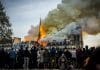


Israel and Iran traded airstrikes early Friday in the midst of a war that has sent shock waves through the global economy and risked drawing Iran’s Arab neighbours directly into the conflict.


ADVERTISEMENT
ADVERTISEMENT
Activists reported hearing strikes around Iran’s capital, Tehran, just as sirens and booms sounded across East Jerusalem as families celebrated the first night of Eid, according to local reports.
Sirens also sounded across a wide swath of the north, from Haifa to the Galilee to the border with Lebanon, sending millions of people to shelters.
Iranian state media reported four missile salvos were fired quickly after one another at Israel, an intense day with a dozen missile launches on Thursday alone, according to Israel’s military.
The attacks followed Israel’s pledge to refrain from more strikes on a key Iranian gas field, and Iran intensified attacks on oil and natural gas facilities around the Gulf.
In its response, Iran set two Kuwaiti oil refineries on fire, struck a Qatari LNG facility, and slightly damaged an Israeli oil refinery. Saudi Arabia, which has been pumping large volumes of oil west toward the Red Sea to avoid the Strait of Hormuz, said its SAMREF refinery in the Red Sea port city of Yanbu was hit.
Early Friday, heavy explosions shook Dubai as air defenses intercepted incoming fire over the city, where people were observing Eid al-Fitr, the end of the holy Muslim fasting month of Ramadan, and mosques made the day’s first call to prayers.
In Iran, millions observed ‘Nowruz,’ a Persian New Year holiday that coincides with the spring equinox rooted in Zoroastrian tradition dating back millennia. Amid the current war, many Iranians stayed indoors, abandoning the usual travel or gatherings this year.
Trump and Netanyahu split on gas field attack
Meanwhile late Thursday, Israeli Prime Minister Benjamin Netanyahu said, at the request of US President Donald Trump, Israel will hold off on any further attacks on Iran’s offshore South Pars gas field.
The aftermath of the strike left Trump and Netanyahu facing questions on whether they’re entirely in sync in prosecuting the war that began as a closely coordinated joint attack on Iran.
During an Oval Office meeting with Japanese Prime Minister Sanae Takaichi on Thursday, Trump told reporters that he neither agreed with nor approved of Israel’s attack on the world’s largest gas field, which is an energy lifeline for Iran.
“I told him, ’Don’t do that,’” Trump said of Netanyahu’s decision to strike. “We get along great. It’s coordinated, but on occasion he’ll do something. And if I don’t like it — and so we’re not doing that anymore.”
Earlier, Trump, in a fiery social media post, claimed to know nothing about the attack.
Speaking in a televised address on Thursday, Netanyahu said that Israel “acted alone” and that he’s agreed to Trump’s request that Israel hold off on any further attack on Iran’s giant gas field.
The prime minister also sought to downplay any space between him and Trump and said that Iran no longer has the ability to enrich uranium or make ballistic missiles.
Since the US and Israel launched the war on 28 February, Iran’s top leaders have been killed, including its revered supreme leader, Ayatollah Ali Khamenei, killed in the war’s opening salvo.
Still, Iran — now led by the son of the supreme leader remains capable of missile and drone attacks and has shown no signs of backing down despite its severely degraded military capability.
Its stranglehold on the Strait of Hormuz, a strategic waterway through which a fifth of the world’s oil is transported, has put global fuel supplies under intense pressure.
On Thursday, Brent crude oil, the international standard, briefly surged above $119 (€102.97) a barrel, up more than 60% since the war started, just as the European benchmark for natural gas prices also rose sharply and has roughly doubled in the past month.