

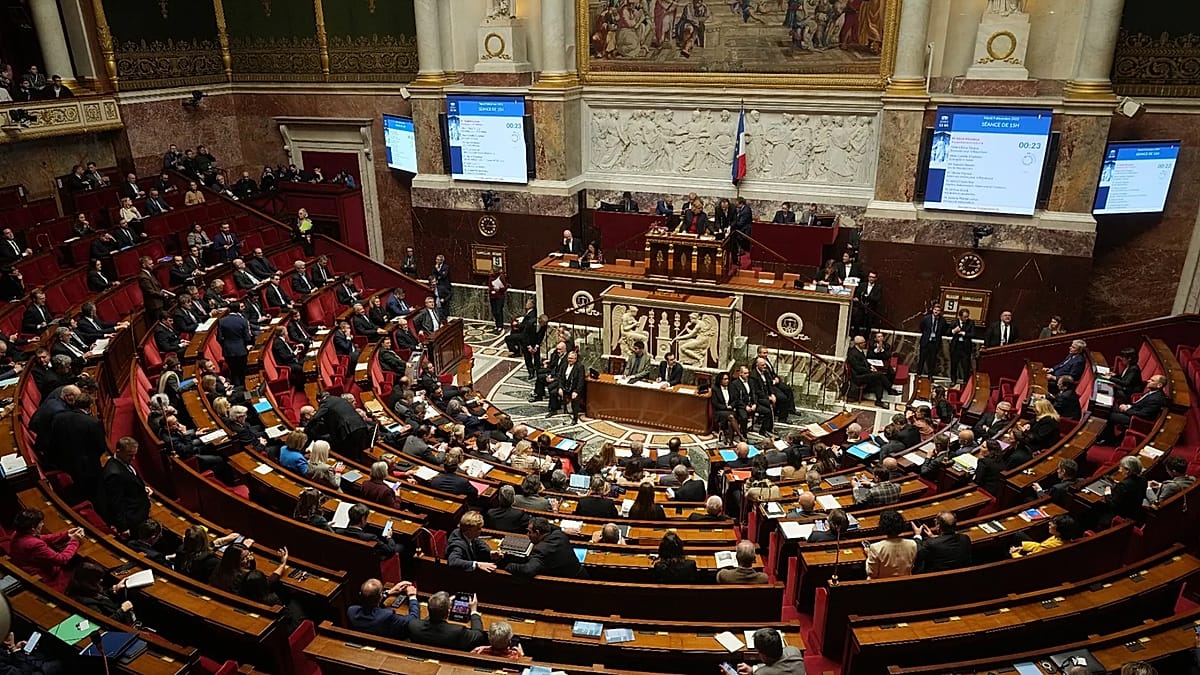
The French government, led by Prime Minister Sébastien Lecornu, survived two no-confidence motions tabled in the lower house of parliament on Friday over its decision to pass part of a long-overdue 2026 budget without a vote from MPs.
As expected, neither the moderate-left Socialist Party nor the conservative Republicans supported the motions, allowing Lecornu to remain in power and avoid another government collapse.
The first motion was submitted by the hard left France Unbowed (LFI), while the second came from the far-right National Rally (RN).
A total of 269 MPs voted in favour of the no-confidence motion presented by the hard left, whereas 288 votes were required to bring down the government.
Even fewer backed a second no-confidence motion, brought by the far right.
Both groups sought to sanction the government for invoking the controversial constitutional tool Article 49.3 to force through the first part of the budget bill without a vote.
Since Friday morning, the debate in parliament has been intense. French far-right figurehead, Marine Le Pen, denounced what she called budget debates that were “a humiliating parody.”
While acknowledging that the use of Article 49.3 was legal, she argued that it nonetheless amounted to “an abuse of the Constitution.”
On the left, the Socialist Party defended its refusal to support the no-confidence votes by warning of political instability.
Socialist MP Laurent Baumel warned against “a political crisis” if the government were to fall.
The Socialists have refrained from trying to topple the government after Lecornu made last-minute concessions on the budget.
France has been plunged into political turmoil after French President Emmanuel Macron called for snap parliamentary elections in June 2024.
Since then, the National Assembly has been divided into three blocs with no party having an absolute majority.
A similar stance was taken by the conservatives. Nicolas Ray, an MP from the Republican right, argued that parliament should allow the budget to pass, “which is what the French people are asking of us.”
Lecornu then took the stand to defend the government’s approach. The Prime Minister insisted that “compromises have been found” and said he used the tool as a last resort.
While expressing regret over resorting to Article 49.3, he argued that “too many MPs did not want to make a decision.”
By triggering Article 49.3 on the income section, the Prime Minister went back on his promise made on 3 October not to use the mechanism.
Strengthened by the rejection of the two no-confidence motions, the government quickly invoked Article 49.3 once again on the “expenditure” section of the bill.
This will likely prompt further no-confidence motions, which are again expected to fail.
After a brief passage through the Senate, the draft budget is set to return to the National Assembly for a third and final use of Article 49.3, bringing to a close a tense budgetary marathon, if the government survives until then.
France is under mounting pressure to reduce a budget deficit that reached 5.4% of GDP last year.
Paris has committed to reducing the deficit below 3% of GDP, as required by EU rules.