
Belarus became the latest country to join US President Donald Trump’s “Board of Peace” initiative, despite concerns over Minsk’s years-long crackdown on dissenting voices and continued support for Moscow in its all-out war against Ukraine, putting the eastern European country under severe sanctions from Brussels and others.
In a statement on X, the Board of Peace said it “welcomes Belarus as a founding member of our growing international organisation.” It is unclear whether Minsk paid the $1 billion fee to secure permanent membership for Belarus.
The Belarusian Foreign Ministry said in a statement last week Minsk was “prepared to take an active role in shaping a new architecture of global and regional security based on the principles of mutual respect and the unconditional consideration of the national interests of the member states.”
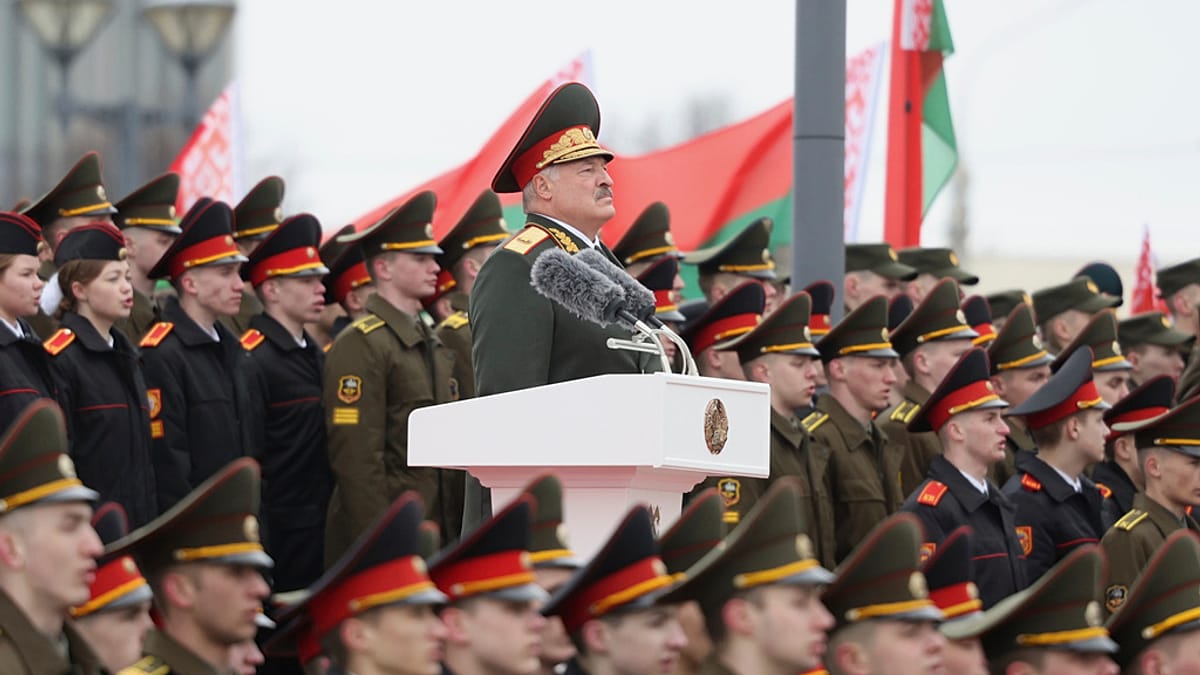
Strongman President Aliaksandr Lukashenka’s government has been under significant pressure from EU sanctions imposed following the disputed 2020 presidential election and violent crackdown on protesters and other opposing voices, with further measures introduced after the country allowed Russia to use its territory to launch its full-scale invasion of Ukraine in early 2022.
While Washington has eased its own sanctions on Minsk in return for the release of Belarusian political prisoners, concerns persist over Lukashenka’s firm grip on the country since 1994 and his role in Russia’s war.
Lukashenka remains the key ally of Moscow and President Vladimir Putin, with Russia deploying its nuclear-capable Oreshnik hypersonic missile to neighbouring Belarus last month.
While the Kremlin did not specify how many missiles were sent and whether they were fitted with nuclear warheads, Lukashenka said that up to 10 Oreshnik systems will be stationed there.
The Belarus strongman leader also had choice words for Europe over the years, stating last year, “I don’t give a damn about the West,” after Brussels mulled a fresh raft of sanctions as he won his seventh consecutive election since 1994.
The vote was broadly understood to be rigged in his favour given his iron rule over the country and complete control of its institutions, and yet another repeat of the 2020 elections that sparked turmoil.
While fears lingered over the years that Minsk could also join the war in Ukraine on Russia’s side, Lukashenka has pitched himself as a peacemaker and Belarus as a possible venue for talks between Moscow and Kyiv, stating last year that “some kind of resolution” would manifest itself at some point.
“We will probably continue to conflict for a long time. We are Slavs, if we start to conflict, it will last for a long time. But there will be a resolution. The light at the end of the tunnel will appear this year,” he said.
Since then, the US-led peace talks have progressed at a snail’s pace, mostly due to Moscow’s maximalist demands, including taking full control of regions it partly occuppied in Ukraine’s east.
What happened in Davos?
Belarus is among more than 20 countries that have agreed to join US President Donald Trump’s Board of Peace, an initiative that has expanded beyond its original remit of overseeing the Gaza ceasefire to what Trump describes as broader conflict mediation.
Trump signed the charter formally launching the board at the World Economic Forum in Davos last Thursday, flanked by founding member leaders including Argentina’s Javier Milei and Hungary’s Viktor Orbán. “We’re going to have peace in the world,” Trump announced.
The board, with Trump as permanent chairman even after leaving office, was initially conceived as a small group monitoring the Gaza truce but now includes invitations extended to dozens of nations.
Trump said last week he expects more than 50 countries to join, in what appears to challenge the United Nations Security Council’s traditional role in international conflict resolution.
Countries seeking permanent membership face a $1 billion contribution fee. Non-paying members would have a three-year mandate, according to a copy of the charter obtained by media outlets.
Trump previously defended inviting Lukashenka and Russia’s Vladimir Putin, saying he wanted “everybody” who was powerful and could “get the job done”. Putin said he was consulting “strategic partners” over Moscow’s involvement.
Several European nations including France, Germany, Norway and Sweden have declined invitations, while China, Russia and India remain noncommittal. Trump revoked Canada’s invitation right after Prime Minister Mark Carney’s speech in Davos, where he warned of “rupture” in world order.
The plan’s critics were quick to slam it right after the Davos signing ceremony, which brought together leaders as diverse as Kosovo and Indonesia, with Washington’s Western allies notably absent.
“I think they were trying to duplicate — replicate — what happened when the United Nations came about,” Amnesty International Secretary-General Agnes Callamard said. “But frankly it was a very poor and sad attempt to repeat what happened in the 1940s.”
US Secretary of State Marco Rubio described the board as “a group of leaders that is about action,” saying its job “first and foremost” is ensuring the Gaza peace deal becomes enduring before looking elsewhere. He acknowledged details of operations remained unclear, calling it a work in progress.