

Published on
The last-minute ceasefire announcement in the Iran war was met with widespread relief across the Gulf on Tuesday night as the region braced for the worst amid the spiralling war of words between Washington and Tehran.


ADVERTISEMENT
ADVERTISEMENT
But neither Iran nor the United States said when the ceasefire would begin, and that became evident on Wednesday morning when the United Arab Emirates and Bahrain reported new Iranian attacks.
Euronews journalists in Dubai received air-raid alerts early Wednesday morning and observed renewed daily fighter-jet defence activity over the city throughout the morning.
The UAE announced a new attack was launched on its Habshan gas complex, ending the short-lived relief that a ceasefire would bring the much-wanted calm.
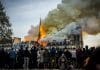
The UAE said it would suspend production at the Habshan gas complex, as falling debris from an interception of an attack caused multiple fires at the facility, with two Emiratis and one Indian national suffering minor injuries, according to the Abu Dhabi media office.
Euronews journalists in Doha received air raid alerts early Wednesday morning after a prolonged Iranian raid on Tuesday night before the ceasefire announcement, with at least eight intercept booms shaking the city and diverting inbound flights towards Doha for an hour.
And in Bahrain, new blasts were heard after sirens sounded again on Wednesday morning, urging residents to shelter. The renewed attacks come after a night of Iranian strikes, which damaged houses in the Sitra area, injuring two people from shrapnel falling after the interception of an Iranian drone.
In Iran’s capital Tehran late Wednesday morning, the public heard what sounded like air defences firing. Later reports suggested it was a drill, without elaborating, the Associated Press reported.
The US and Iran said Tuesday night that they had agreed to a two-week ceasefire that includes reopening the Strait of Hormuz.
US President Donald Trump initially had said Iran proposed a “workable” 10-point plan that could help end the war launched by the US and Israel in February, but he later called it fraudulent, without elaborating. Neither Tehran nor Washington said when the ceasefire would begin.
Israeli Prime Minister Benjamin Netanyahu’s office said it supported Trump’s decision to suspend strikes against Iran for two weeks, but that it did not include pausing the war with Hezbollah in Lebanon.