


Mayeni JonesBBC Africa correspondent

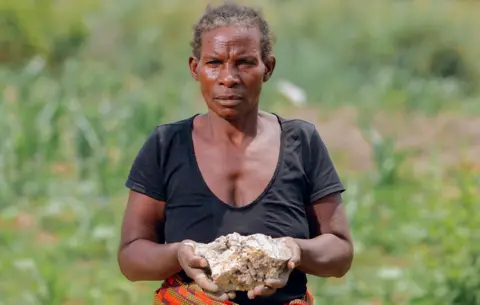
Even before the dam collapsed, Lamec did not feel safe working at the copper mine.
“If our work protective gear gets damaged, it is not always replaced,” he tells us. “We have to take a risk and use it again.”
He is talking to the BBC in a car on a quiet backroad near a village in northern Zambia, too nervous to speak to us in public or to use his real name, for fear that speaking to the press might cost him his livelihood.
When he turned up for his shift one day in February, he tells us, he found that one of the dams at the Chinese-owned mine had been closed.
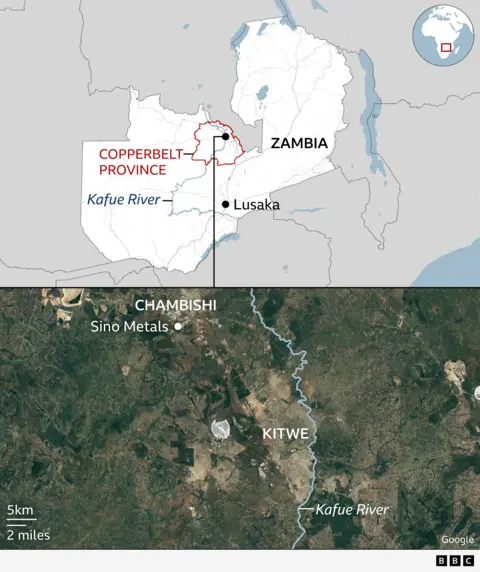
The tailings dam – used to store toxic by-products from the copper mining process, including heavy metals like arsenic, mercury and lead – had collapsed into a tributary connected to the Kafue, Zambia’s longest river and a major drinking water source.
At least 50,000 tonnes of acidic debris spilled out into the surrounding waterways and farmland, according to the government. Some environmentalists, however, claim as much as 1.5 million tonnes was spilled, with one expert saying a full clean-up could take longer than a decade.
The spill has killed the fish around the towns of Chambishi and Kitwe, made the water undrinkable and destroyed crops, farmers have told the BBC.
There are fears that, now the rainy season has started, heavy metals still sitting in the mud will further infiltrate the land and waterways, causing a second wave of pollution. Toxic metals that can cause kidney damage and cancers, as well as gastric and intestinal issues, could be carried downstream to the capital, Lusaka, says Dr Mweene Himwiinga, a senior lecturer at Zambia’s Copperbelt University.
The Chinese embassy in Lusaka disputes the scale of the damage and told the BBC it welcomed the establishment of an independent investigation into the incident. The Zambian government, it said, had reported that the pollution was contained to a confined area, water acidity levels had returned to normal limits and that ongoing checks showed no lasting public-health risks.


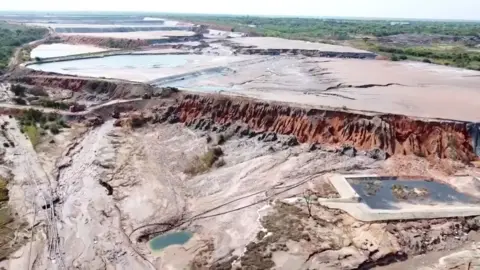
Lamec, like his country Zambia, finds himself in a difficult position. The mine is owned by Sino-Metals Leach Zambia, a subsidiary of a Chinese state-owned firm, which has created – according to Chinese sources – more than 2,000 jobs.
Chinese companies like these provide jobs and much needed revenue in Africa. Although the US has recently become the biggest foreign investor across the continent, China is still one of the largest investors in Africa’s rich minerals and metals industry – not least in Zambia’s Copperbelt Province, the scene of the dam collapse.
More than 30,000 jobs have been created by Chinese companies across Zambia, according to the Chinese embassy. Investment from China was estimated to be worth $1.7bn (£1.3bn) last year. And – in a sign of the close links between the two countries – Chinese Premier Li Qiang visited Zambia late last month, ahead of the G20 Leaders’ Summit in South Africa.
But China has also been accused of neocolonialism, with critics arguing that its infrastructure loans trap African countries in unmanageable debt, that it doesn’t upskill local workers, preferring to bring its own in instead, and that its focus on mineral extraction sometimes comes at the expense of safeguarding the environment.
In September, 176 farmers filed an $80bn (£58bn) lawsuit against Sino Metals and NFC Africa, the Chinese firm that owns the land the mine is on. It is one of the biggest environmental lawsuits in Zambia’s history, with the farmers alleging the spillage has already affected 300,000 households.
They say the dam’s collapse was caused by a number of factors, including engineering failures, construction flaws and operational mismanagement.

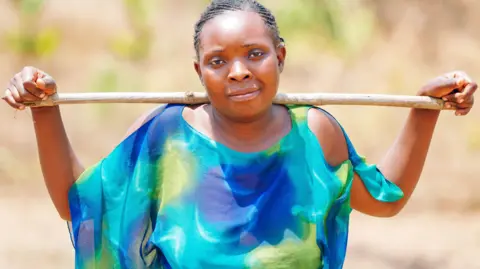
The lawsuit is being seen by some as a test case of how much African countries can hold China accountable for wrongdoing in their territories.
“All eyes are on this case,” says Prof Stephen Chan from the University of London’s School of Oriental and African Studies.
“Because of the huge extent of the damage that has been caused, the huge extent of the carelessness that was very obviously involved.”
People found it hard to believe at first “because something of this scale had not happened before,” he adds.
The Chinese embassy in Zambia says Sino Metals has cooperated fully with the investigation into the incident, that compensation has been paid to 454 households and that all staff at the site have continued to be employed and receive their salaries, despite a six-month pause in mining.
Some analysts, however, argue the incident shows that Zambia needs to prioritise safety, sustainability and the national interest when dealing with Chinese companies. The power dynamic could be further complicated by the estimated $5bn debt (£3.7bn) Zambia owes to China.
But this debt does not hamper the Zambian government’s ability to deal with the crisis, insists the Permanent Secretary for Green Economy and Environment, Dr Douty Chibamba.
“There is no treating them [China] with kid gloves here,” he told the BBC in a rare, sit-down interview. “We don’t care whether we owe them, that’s not the issue.”
Zambia is not alone in owing money to the Chinese. Between 2000 and 2023, 49 African countries are believed to have signed $182.3bn (£139.4bn) worth of loans with Chinese lenders.

In Copperbelt Province, Lamec tells us he was really broken by the spill affecting his family. “We were told that the waterways now had acid in them, and that we were not supposed to use the water.”
For two weeks after the spill, Lamec says he and his family weren’t allowed to use the local water until it had been sprayed with lime to help reduce the acidity.
He took the job at the dam because, he says, he has no other way to make a living, but now feels conflicted about working there.
Copper mining has been the economic backbone of this region for more than a century. The metal makes up 70% of Zambia’s exports and accounts for 15% of its GDP.
The industry is set to grow further, with plans to more than triple production in Zambia by 2031, according to plans laid out by the government last year.
In the village of Twalima, it has been a struggle to grow anything since the spill, say farmers Abigail Namtowe, 28, and Frederick Bwalya, 72.
Farming was the main source of food and income for Ms Namtowe’s family, and her six year-old daughter is now very hungry and malnourished, she told us.
“I’ve tried to grow my maize, I’ve tried everything so the hunger won’t kill my child, but it’s too much.”
Mr Bwalya has lived in Twalima for 33 years. Strong and energetic, we meet him working on his farm which he tends to daily. “Farming is not going well because the soil is not clean,” he says.
He also describes a severe pain in his leg which won’t go away and makes it difficult for him to move. “The doctor says the contaminated water could be causing this,” he adds.
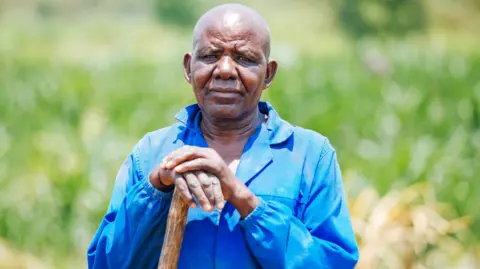
Sino Metals has promised to build a borehole away from the contaminated stream at the bottom of his farm, he says, but that hasn’t happened yet. He believes that water deeper underground would be safer.
The stream used to be teeming with fish, say Mr Bwalya and his neighbours, adding that since the spill, there haven’t been any.
The BBC asked Sino Metals about the alleged promise to build boreholes on the land of affected farmers. We also put Lamec’s allegations that he does not feel safe working at the company, but the firm did not respond.
Fifty kilometres (31 miles) away from Frederick Bwalya’s village, in Kamwatimpa, we saw schoolchildren swimming in a tributary of the Kafue river.
Some mothers – still worried about the pollution – said they had told their children not to go into the water.
But the government says it sampled 21 sites across Copperbelt Province in September, and that the concentrations of heavy metals were within national safe limits.
Now the rainy season has taken hold, the power to stop a second wave of pollution seeping into the soil, and carrying heavy metals down the river to the rest of the country, is in the hands of the government and Sino Metals.
The clean-up has been delayed by issues between the consultants hired to assess the damage and Sino Metals, Dr Chibamba told the BBC, when asked why some of this work hadn’t been done earlier.
Meanwhile, Dr Himwiinga warns that failure to deal with the situation “may be catastrophic”.
“They [the heavy metals] could be there for years, and their effects could be felt for a very long period of time, by farmers… who rely on that water to irrigate their crops,” she says.
“According to research carried out by Copperbelt University, this could go on for even over 10 years, unless remediation efforts are put in place.”
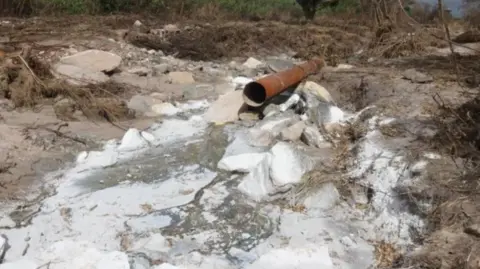
The Zambian government says it is aware of this and has instructed Sino Metals to put mitigations in place to stop secondary pollution – including planting trees, to bring down levels of pollution in the air and soil, as well as spreading lime to reduce acidity. These measures are currently being implemented, according to the authorities.
Sino Metals might have to pay more after a full assessment of the area has been made, says the government. At the time of the spill, the company pledged to compensate the affected communities and restore the environment.
Financial payments have already been made to some locals in the Copperbelt. Some told us they had received as much as $3,000 (£2,400) in compensation from Sino Metals – but others said they had got as little as $700 (£500) from the company.
One contract we saw suggests that some locals have signed away their entitlement to any further compensation when they accepted these initial payments.
But the presence of a second superpower in the country may help the Zambian government to get even more money out of Sino Metals, according to Prof Stephan Chan. The United States has also been courting the southern African country economically and politically. Zambian copper, important in the global transition to cleaner energy, is in high demand – as well as reserves of another metal, cobalt, used in electric car batteries.
“The Chinese don’t have that much leverage over Zambia because it has a foreign policy that also speaks to the Americans,” says Prof Chan. “The last thing the Chinese want is to drive the Zambians closer to the Americans.”
Total trade between Zambia and the US was worth an estimated $296m (£226m) in 2024. And there are recent signs that both countries are becoming closer diplomatically, with some regional commentators suggesting the US may be turning to Zambia as a preferred ally in southern Africa because of increased tensions with neighbouring South Africa.
African countries, including Zambia, are choosing to work with different superpowers to meet their needs, Prof Chan says.
“It’s not Africa being taken for a ride, it’s Africa coming of age, becoming a player in the world, with all of the different actors in the world.”
African governments are “not always getting it right”, he says, however “this is not something you get right at the very beginning. Africa is becoming fully integrated in a complex world, making mistakes, the same kind of mistakes that other countries everywhere make.”
For its part, China denies taking advantage of Zambia, and told the BBC it was “grossly unfair” to characterise Beijing’s relationship with African countries as neocolonial.
“Most in Zambia would agree that the Chinese investors and the Chinese community as a whole are bringing to this country the much needed capital, technology, skills training opportunities, job creation and managerial expertise – and they are doing their best to blend in as law-abiding and responsible players,” a statement from the Chinese embassy in Lusaka says.
“It would be grossly unfair to label China-Zambia and China-Africa cooperation as neocolonialism based on the opinions of very few, while neglecting the larger picture of win-win cooperation between China and Zambia, and the wider Africa.”
Additional reporting by Ed Habershon